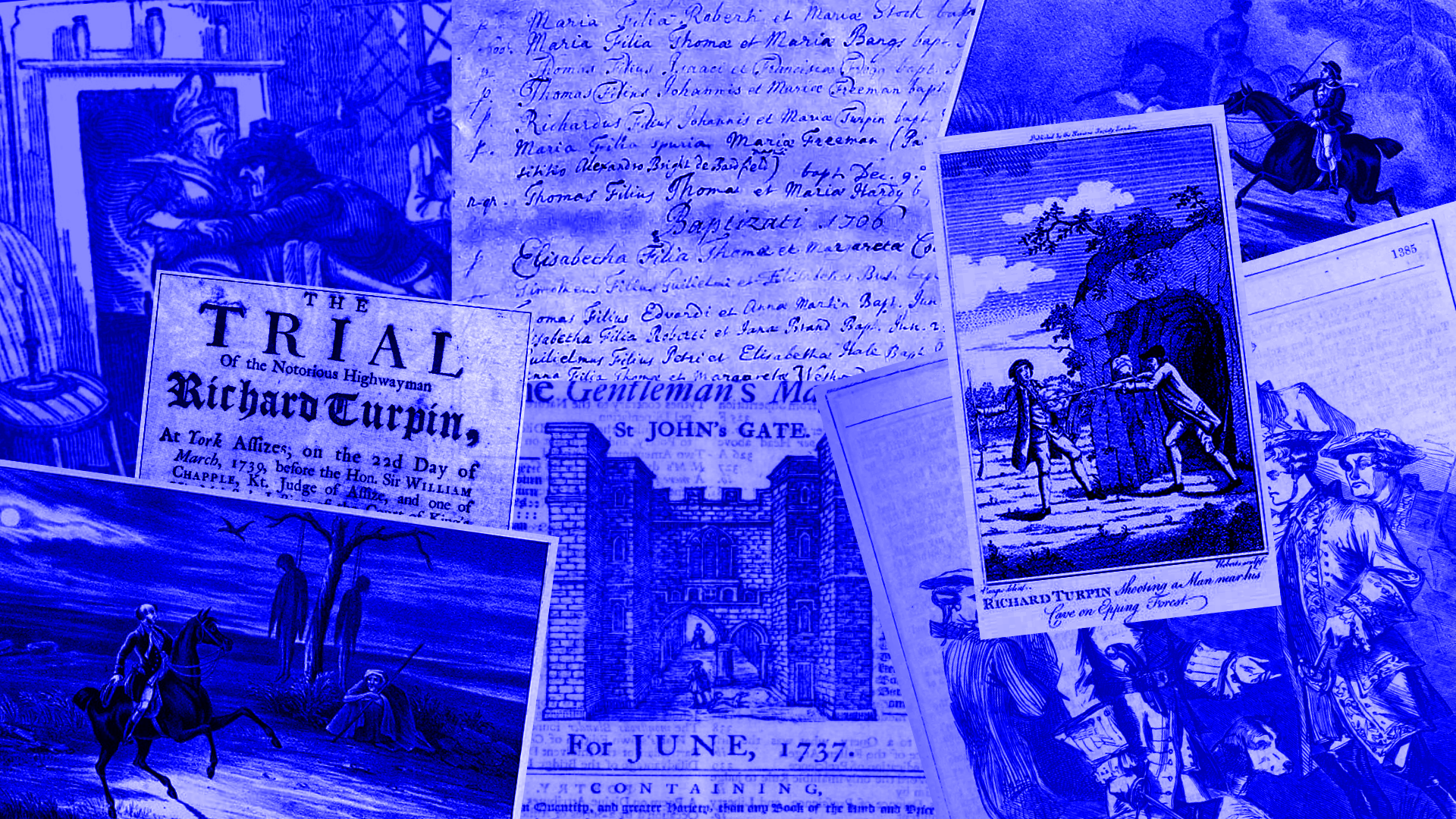

DICK TURPIN:
THE REAL HISTORY
No Black Bess. No midnight ride to York. No robbing the rich to give to the poor. That's the fairy tale. This is what actually happened.
Dick Turpin was a butcher's son from Essex who ran out of road and ended up on a scaffold at thirty-three. He was violent, reckless, selfish, and occasionally brave. He terrorised elderly farmers. He shot his best friend. He stole horses and lied about his name.
He was no gentleman of the road. He was a violent terror of the highways. This is the story the myth buried.



TURPIN: THE REAL STORY
No Black Bess. No midnight ride to York. No robbing the rich to give to the poor. That's the fairy tale. This is what actually happened.
Dick Turpin was a butcher's son from Essex who ran out of road and ended up on a scaffold at thirty-three. He was violent, reckless, selfish, and occasionally brave. He terrorised elderly farmers. He shot his best friend. He stole horses and lied about his name.
He was no gentleman of the road. He was a violent terror of the highways. This is the story the myth buried.
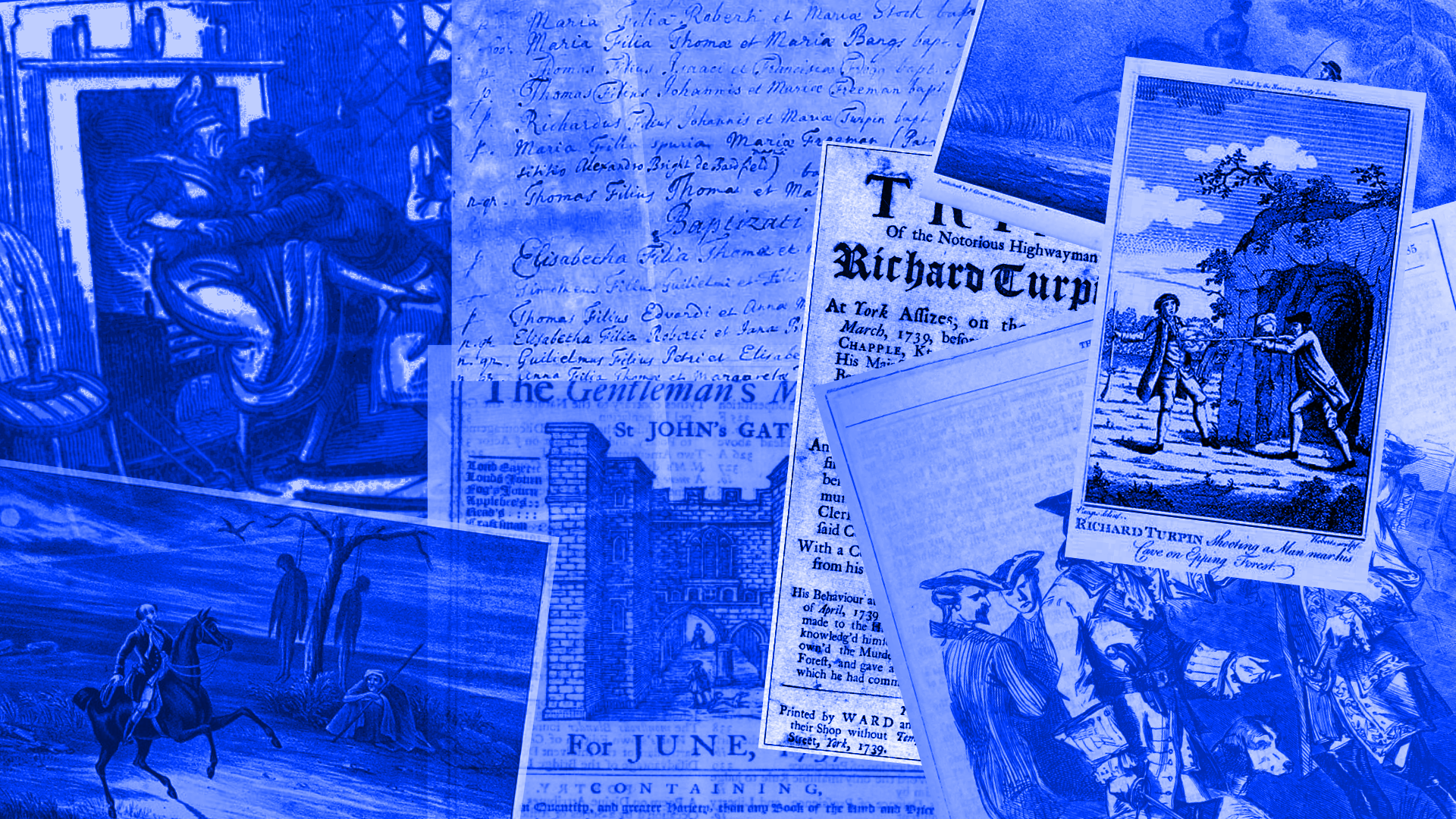
Essex, 1705-1733
Richard Turpin was baptised on 21st September 1705 at Hempstead, Essex, the fifth of six children of John Turpin - a farmer and innkeeper of the Bell Inn - and Mary Elizabeth Parmenter. He received a basic education under the village schoolmaster James Smith, a man whose sharp memory would later prove fatal.
Apprenticed to a butcher in Whitechapel, Turpin set up his own trade on the edge of Epping Forest and married Elizabeth Millington, known as Betty, around 1725. The business was precarious. The forest was close. And the Essex deer poachers needed someone who could process and sell what they took. Turpin, a young butcher with the skills and the contacts, became their man.
It was a short step from deer to cattle, and from there into the orbit of the Gregory Gang, led by Samuel Gregory with his brothers Jeremiah and Jasper, alongside Joseph Rose, Thomas Rowden, John Wheeler, and Mary Brazier, who fenced their spoils. By autumn 1734, the gang had escalated from poaching to violent housebreaking, descending on isolated farmhouses across Essex with guns and the willingness to use them.
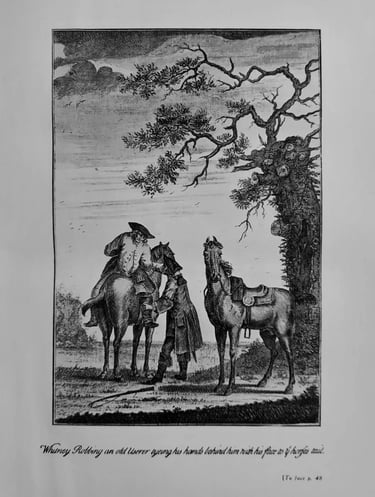
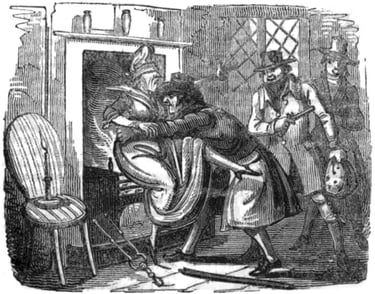
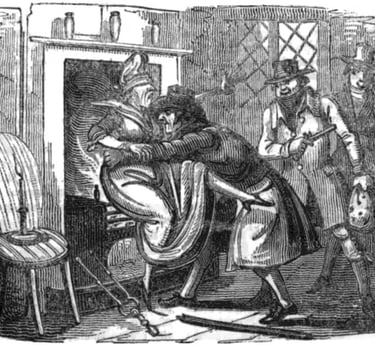
Their crimes grew increasingly savage. At Barking, they robbed 73-year-old farmer Ambrose Skinner of £300. At Loughton, they threatened the elderly Widow Shelley with being roasted over her own fire. At Edgware, they tortured farmer Joseph Lawrence. One contemporary newspaper called on Parliament to deploy the entire British Army to surround Epping Forest's sixty thousand acres and bring Turpin to justice. He had become, the paper said, openly dangerous to the lives as well as the fortunes of the people of England.
Not a hero. A problem.

Keeper Mason & the Cave, 1734–1737
In December 1734, while Turpin was in London drinking away his share of the Barking robbery, the Gregory Gang decided not to wait for him. They raided the home of William Mason, Keeper of Epping Forest, beat him severely, ransacked the house room by room, and smashed a china punchbowl on the stairs that turned out to have 120 guineas hidden inside. Mason's daughter escaped by running out and hiding in a pigsty. When the gang found Turpin afterwards they shared the money with him anyway.
Mason did not forget.
By early 1735, the law was closing in. The gang was broken apart, one by one arrested, tried and hanged at Tyburn. Turpin survived, retreating into the forest with Thomas Rowden, hiding in a cave near Loughton while Mason and the other keepers hunted them. By 1737 Turpin had resurfaced as a highwayman, working the roads with Matthew King and Stephen Potter, but the forest was no longer safe and he knew it.
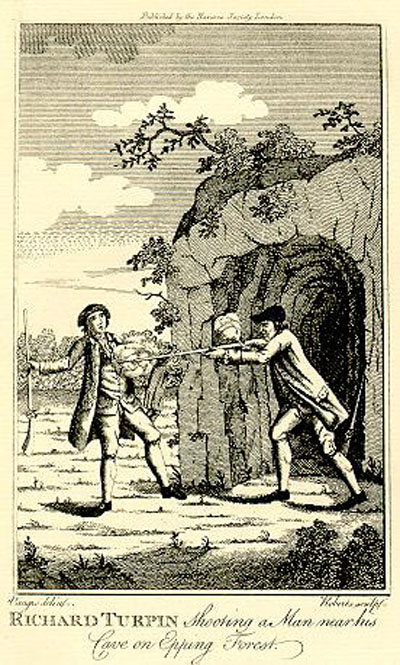
On 4th May 1737, Thomas Morris, a servant to keeper Henry Tomson, found Turpin's hideout. He walked in and announced himself: "I have found a Turpin."
Turpin picked up his gun and shot him dead.
The London Gazette ran his description that same week. "A butcher by trade... about 5 Feet 9 Inches high, brown Complexion, very much mark'd with the Small Pox." Two hundred pounds reward. He wasn't just a thief anymore. He was a killer, and the whole country was looking for him.
And Mason kept looking too.
Tom King, 1737
The partnership with Matthew King, the man the legend reinvented as the dashing "Captain Tom King," fell apart that same year.
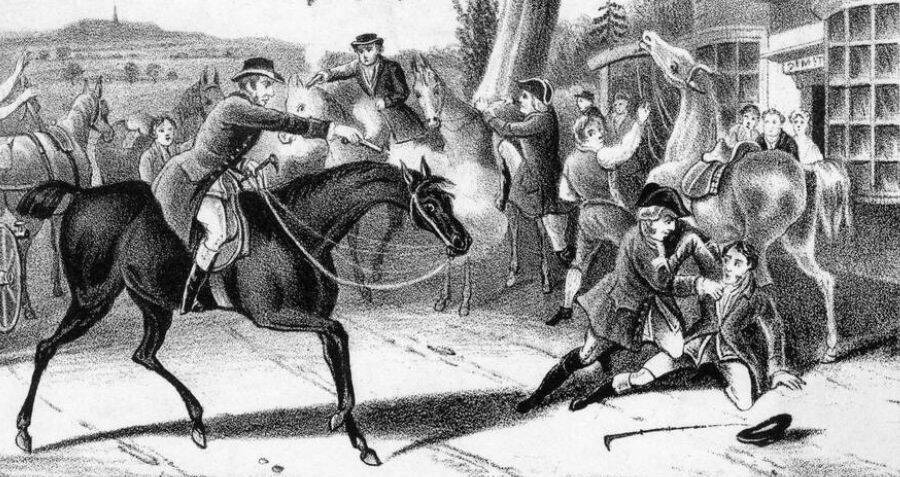
A stolen horse got traced to the Red Lion inn in Whitechapel. Constables showed up. Shots were fired. Accounts differ on exactly what happened next: some said Turpin shot King himself trying to hit a constable; others said the landlord Richard Bayes pulled the trigger.
What's agreed is what Turpin reportedly said in the aftermath. "I have lost the best fellow-man I ever had in my life."
King died a week later. Turpin turned his horse north and didn't look back.
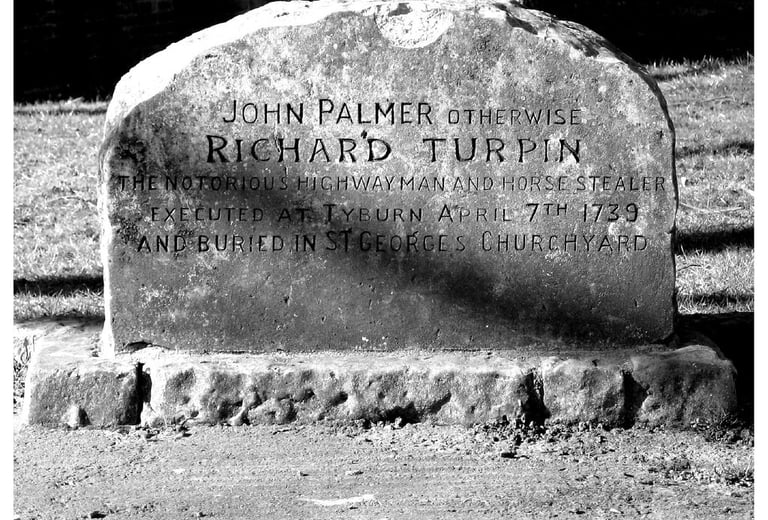
John Palmer,
1737–1739
He settled at the Ferry Inn at Brough in the East Riding of Yorkshire, calling himself John Palmer. The name was almost certainly no accident. His mother's maiden name was Parmenter. Palmer was close enough to carry a private echo of home. He passed himself off as a gentleman farmer and horse dealer. He hunted with the local gentry. He drank well. He stole horses in Lincolnshire and sold them across the border. He was charming, plausible, and for nearly two years, invisible.
His downfall started with a cockerel.
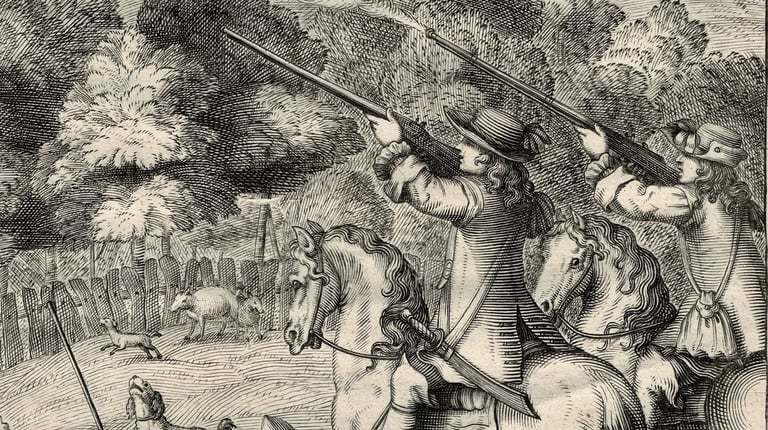
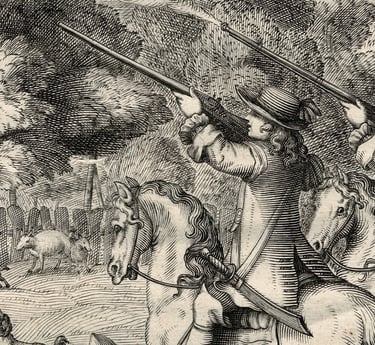
On 2nd October 1738, he and some companions were riding back from a shooting trip, drunk and empty-handed. On the way through Brough, Turpin raised his gun and shot a neighbour's game-cock dead in the street. When a man named John Robinson rebuked him for it, Turpin told him to wait until he had reloaded, and then he would shoot him too. Three East Riding justices, George Crowle, Hugh Bethell and Marmaduke Constable, came to Brough and took depositions. Turpin refused to give any assurance of good behaviour and ended up in the Beverley House of Correction. When horse theft charges emerged, they moved him to York Castle to wait for trial.
From his cell, he wrote to his brother-in-law Pompr Rivernall back in Hempstead, asking for a character reference. Rivernall refused to pay the sixpence postage. The letter sat at the Saffron Walden post office, uncollected, until a man called James Smith walked past and recognised the handwriting.
James Smith. The schoolmaster who had taught Turpin to write thirty years before.
York, 1739
Smith travelled to York. He identified "John Palmer" as Richard Turpin on 23rd February 1739. Collected £200 for his trouble.
Turpin was tried at York Assizes on 22nd March 1739 before Sir William Chapple. Two charges of horse theft. No defence barrister. Two witnesses from his home village of Hempstead, Smith and a man named Edward Saward, stood up in court and swore that John Palmer was Richard Turpin.
Turpin admitted in court that he was Dick Turpin, but claimed the alias was simply because he was in debt. He said he had bought the horses legitimately, produced no witnesses to prove it, and asked the judge to postpone proceedings. He had assumed, he said, that he would be tried back in Essex, and had not summoned anyone to speak for him. The judge was unmoved. He was convicted and sentenced to death.
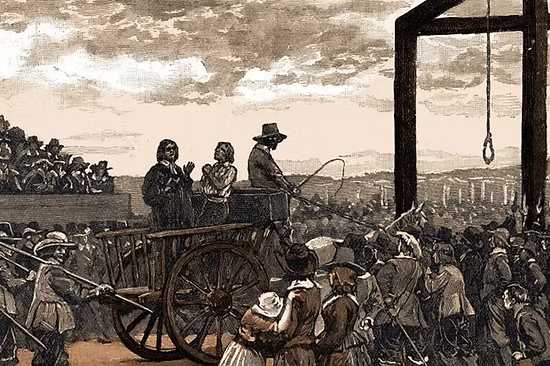
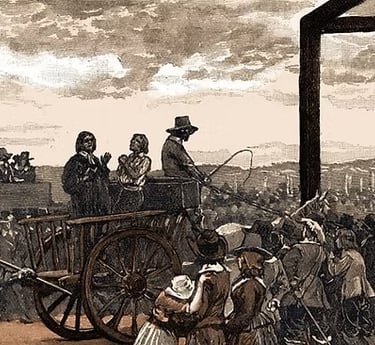
Before his execution he spent £3 on a new frock coat, shoes, and hired of five professional mourners. He gave a gold ring and two pairs of shoes to a married woman in Brough he had been seeing, while acknowledging he still had a wife of his own. He chatted with the executioner. He bowed to the crowd. Contemporary accounts put the spectators in their thousands. His hangman, Thomas Hadfield, was himself a former highwayman, spared the rope in exchange for doing the job.
On 7th April 1739, at Knavesmire, Turpin threw himself off the ladder before the hangman could push him, taking about five minutes to die.
Dead at Thirty-three years old.
The Myth Factory
Within months, the pamphlets started. By the end of 1739, two competing accounts had already begun softening the edges. Richard Bayes wrote his Genuine History. Thomas Kyll published his Trial of the Notorious Highwayman. The Newgate Calendar leaned into the theatrical death and quietly dropped the torture of elderly farmers.
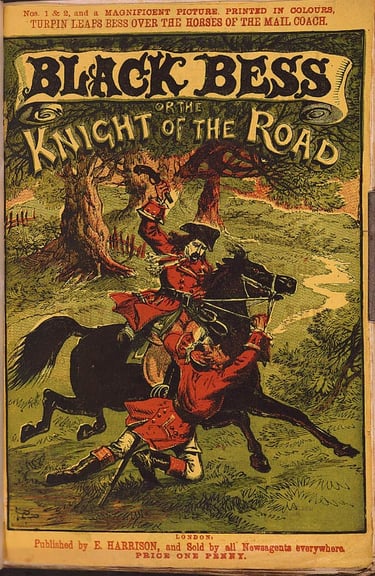
Then in 1834, William Harrison Ainsworth wrote Rookwood and invented Black Bess. No historical source names Turpin's horse. The overnight ride to York was borrowed wholesale from an earlier highwayman, William Nevison, who supposedly did it in 1676. None of it happened. All of it stuck.
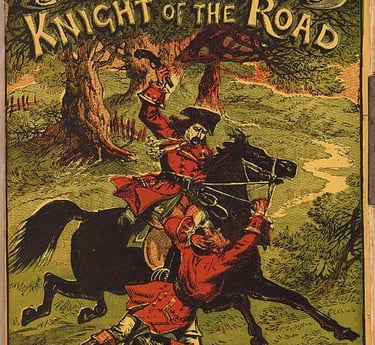
Rookwood was a sensation. It spawned decades of penny dreadfuls, including Black Bess, or the Knight of the Road, which ran to 254 weekly parts between 1867 and 1868. By the time it was done, the pockmarked cattle thief who beat old women for their savings had been completely replaced by a gallant rebel on a magnificent horse. A better story for an age that needed its outlaws to be romantic.
The truth was better. They just didn't want it.
Ten episodes. Full cast. No Black Bess. No midnight ride.
Turpin is a gritty, full-cast audio crime saga from Big Finish. Fast, visceral, and darkly funny. The punk version of 18th-century England where loyalty, greed and class collide.
We go back to the documented record and ask what actually happened when an impatient Essex butcher decided he wanted his share of the new money and wasn't willing to work for it. The farmhouses. The forest cave. The keeper and his drive for revenge. The cockerel. And the schoolmaster who never forgot a face.
Our Turpin is loud, magnetic and completely out of control. He talks his way into any room and shoots his way out. He burns through everyone who tries to help him. He wants the money, the notoriety, the legend, and gets all three.
He also gets the rope.




Primary source: Arty Ash & Julius E. Day, Immortal Turpin: The Authentic History of England's Most Notorious Highwayman (Staples Press, 1948).
Additional sources: Derek Barlow, Dick Turpin and the Gregory Gang (1973); James Sharpe, Dick Turpin: The Myth of the English Highwayman (2004); Oxford Dictionary of National Biography; The London Gazette; York Assizes records (1739).
Frequently asked questions
Was Dick Turpin a real person?
Yes. Richard Turpin was born in Hempstead, Essex, in 1705 and hanged at York on 7 April 1739 for horse theft. The dashing gentleman highwayman of legend, however, was largely invented by the novelist Harrison Ainsworth in his 1834 book Rookwood, nearly a century after Turpin's death.
How did Dick Turpin die?
He was hanged at the Knavesmire in York on 7 April 1739, aged 33. He was convicted of horse theft after being identified, while in prison under the alias John Palmer, by his old schoolmaster, who recognised his handwriting on a letter sent to his brother-in-law in Essex.
Did Dick Turpin really have a horse called Black Bess?
No. Black Bess was invented by Harrison Ainsworth for his 1834 novel Rookwood and never existed. The real Turpin rode many stolen horses across his career, and it was the theft of one of them, a black mare belonging to Thomas Creasy, that ultimately led to his arrest.
Where was Dick Turpin born?
He was born in Hempstead, Essex, and baptised in the village church of St Andrew on 21 September 1705. His father John was a butcher and the landlord of the Bell Inn. Turpin trained as a butcher himself before moving to Buckhurst Hill and then drifting into crime.
Did Dick Turpin really ride from London to York?
No. The legendary overnight ride was lifted from a story about a different highwayman, John Nevison, half a century earlier. Ainsworth borrowed it for Rookwood and gave it to Turpin. The real Turpin's journey north was a slow, paranoid escape under a false name.
Why is Dick Turpin so famous?
Almost entirely because of one novel. Harrison Ainsworth's Rookwood (1834) reimagined Turpin as a romantic gentleman highwayman with a heroic ride to York and a beloved horse. The book was a runaway bestseller, the myth stuck, and Britain has been retelling Ainsworth's invention rather than the real story for nearly two centuries.